

Event Duration Monitoring
Event Duration Monitoring (EDM) is a regulatory requirement to monitor the frequency and duration of releases from storm overflows, also known as CSOs (Combined Storm Overflows).
Since storm overflows are designed to be passive and operate without intervention, monitoring is important to understand how often this happens which is a requirement set by our environmental regulators. Welsh Water was the first water company to begin installing monitors on our storm overflows which we began back in 2015, several years before our regulators needed us to. This does mean Welsh Water has a lot more data.
Event Duration Monitors
We have EDM on over 99.5% of our overflow assets. The remaining sites are being addressed but will take a bit longer due to challenges such as accessing safely. In the majority cases our monitors help indicate a spill by using a technology called ultrasonic to measure the levels inside our network. There are other types of sensors used such as pressure sensors, flow sensors, pump run signals, and electrodes. The most suitable monitor is chosen depending on the structure of the particular asset, whether an underground chamber or an open channel.
How do we report our EDM data?
EDM data is reported annually to environmental regulators, Natural Resources Wales (NRW) in Wales & Environment Agency (EA) in England and contains 12 months of data. EDM is reported using an agreed method which standardises the way overflows are reported across the UK water industry.
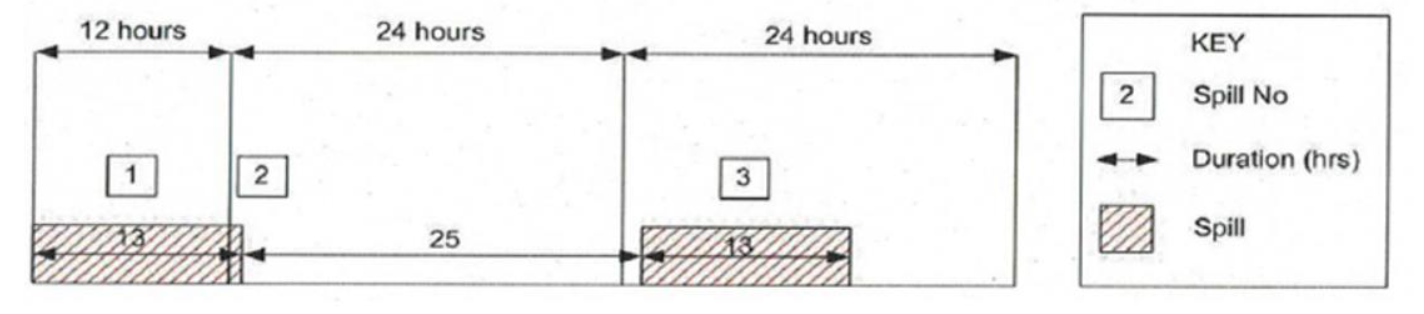
This method is called 12/24 block counting. This method is described below.
The 12/24 spill block counting relates to the agreed reporting method we have with our environmental regulators (NRW & EA).
This method gives us a representative spill number that reflects the performance of the asset, i.e., more spills, the higher the count. The maximum number of spills is 366 in a year (or 367 in a leap year).
EDM data is recorded at 15 minute intervals using various signals, with readings being taken at 00, 15, 30, and 45 minutes past the hour. The 15 minute frequency we report is in agreement with both NRW and EA.
If the overflow has passed the spill point at that time interval, it will be recorded by the EDM. If a small spill occurred between the intervals, it would not be recorded by EDM. Each reading that indicates a spill is counted as the whole 15 minute interval, although the spill may have occurred for less time than this.
The first spill that is recorded opens a 12 hour window. Regardless of how long it spills for within that 12 hour window, it will count for 1 spill – this covers scenario such as:
- It may be just one 15 minute interval reading
- It may be a continuous spill, i.e., continuous readings taken every 15 minutes for up to 12 hours
- It may start and stop during those first 12 hours (overflow, stop overflowing, overflow, stop overflowing etc)
All these variables are reported as 1 spill so it is important to consider duration alongside EDM data for context which will reflect the type of scenarios above likely to apply.
For example, high count but low duration would suggest multiple very short spills.
Once the initial 12 hour window finishes, a subsequent 24 hour window opens.
- If no spill occurs within the 24 hour window, then the counting sequence is reset
- If a spill does occur during the 24 hour window it will count as 1 additional spill, and another 24 hour window will be opened once this one has finished.
- This is repeated until there is a 24 hour window that is free of spills when the counting cycle will be reset again.
Other types of assets that can overflow
Within a wastewater network, there several types of assets that are designed to overflow in certain conditions; some of these are for emergency use only and other will react to very wet weather.
You can learn more about the differences below.
- Storm overflows (or CSOs) are on combined networks, that carry both wastewater and rainwater, and are designed to spill in wet weather conditions when the network is overwhelmed. These are designed to protect homes and businesses from internal wastewater flooding. These are usually passive and are legacy assets installed, in most cases, a long time ago. You can learn more about storm overflows here.
- Storm overflows may also operate in emergency conditions - for example, if there is a blockage further down within the pipe, the flow will be restricted and it could cause a spill. We also use data gathered from EDM monitors to identify potential blockages and take proactive action on our network to reduce these risks.
- Emergency overflows are primarily on assets that use power, such as pumping stations. They are designed to spill in the event of a failure, for example electrical, mechanical, blockage/collapse, rising main failure etc. Our wireless alarm systems will tell us if a failure happens so we can attend and take necessary action as soon as possible.
Unpermitted Overflows
You may also notice that our annual return includes storm overflows that do not currently have a permit as well as emergency overflows that act as storm overflows. We acknowledge these assets need particular attention and a solution as they are not working as designed or permitted to. We are actively working together with our environmental regulators towards bringing these assets into a solution, varying from applying for a permit or investigating if we can safely remove them.
2025 Data
Welsh Water has published its Event Duration Monitoring (EDM) data for 2025, providing a detailed picture of storm overflow activity across our network. This data helps improve transparency and understanding of how our systems perform, particularly during periods of heavy rainfall.
Steve Wilson, Welsh Water’s Chief Operations Officer, explains what the data shows and what it means for customers and the environment.
What does the data show?
In 2025, the number of storm overflow spills decreased by XX% compared to 2024. Weather plays a significant role in this data, as periods of heavy rainfall increase the likelihood of overflows. While 2025 was generally drier overall, higher rainfall at the beginning and end of the year contributed to increased activity during those periods.
Why do Storm Overflows (SOs) spill?
Our sewer system is designed to carry both rainwater and wastewater to treatment works. During heavy rainfall, the volume of water can exceed the system’s capacity. Storm overflows act as a safety valve, releasing excess flow — which is mostly rainwater — into rivers or the sea. This prevents sewage backing up into homes, streets and businesses. You can read more about SOs here.
Are Storm Overflows allowed to spill?
Yes. Storm overflows are strictly regulated by Natural Resources Wales and the Environment Agency. They are only permitted to operate under specific conditions, typically during heavy rainfall. They are not manually activated — they operate automatically when flows exceed system capacity.
Our Storm Overflow Map shows information about our SO activity and you can view the map here.
Why can’t you get rid of Storm Overflows?
This would cost many billions of pounds, it would raise customer bills to an unaffordable level, and the work would take decades.
What are you doing to improve the situation?
Between 2025 and 2030, we will invest £4.2 billion, including £2.5 billion focused on environmental improvements. This includes £889 million specifically to reduce the impact of storm overflows, prioritising those that have the greatest effect on rivers and coastal waters. You can learn more about our investment plans here: dwrcymruplans.com
Can you treat wastewater in a more environmentally friendly way?
We are investing in more environmentally friendly SOs like our new site at Pontyfelin in Torfaen. The site treats and cleans wastewater using a network of reedbeds and pools where the plants naturally filter pollutants and clean the water. This has avoided the need to build large concrete storage tanks, and the result is a low-carbon, environmentally friendly model that brings long term benefits for the local community and wildlife.